
Everyone knows you look a word up in the dictionary to find out what it means, right? Maybe not so much. Good writers and copy editors often consult a dictionary to learn more about words they already know in a general way. We check dictionaries to “verify and clarify,” I say – to double-check the spelling, the proper way to use the word within a sentence (grammar and usage), and subtle shades of meaning (Does odorous have the right connotations, or would we be better off with fragrant? Rescind, recant, or withdraw?)
Sense, subsense, and core sense

In addition, most words can mean more than one thing. We expect separate main entries and different meanings for rose (past tense of rise), and rose (a type of shrub or its flower), but often we don’t notice how many different senses (and subsenses) a word may have – not until we’re in the thickest part of crafting a sentence or unpacking a dictionary entry!
 Senses are the more nuanced, distinct but related meanings within a single definition of a word. In the eleventh edition of Merriam-Webster’s Collegiate Dictionary, even within the one definition for rose as it somehow relates to the plant or flower, there are subdivisions. The rose as a plant and flower is one sense. Another object that resembles a rose flower (compass rose, ornament on a shoe, etc.) is a second sense. An easy task is part of the third sense, and so on.
Subsenses are finer distinctions of meaning within the same sense. For example, the first sense for rose distinguishes between (a) the genus, or type of shrub, and (b) the flower itself.
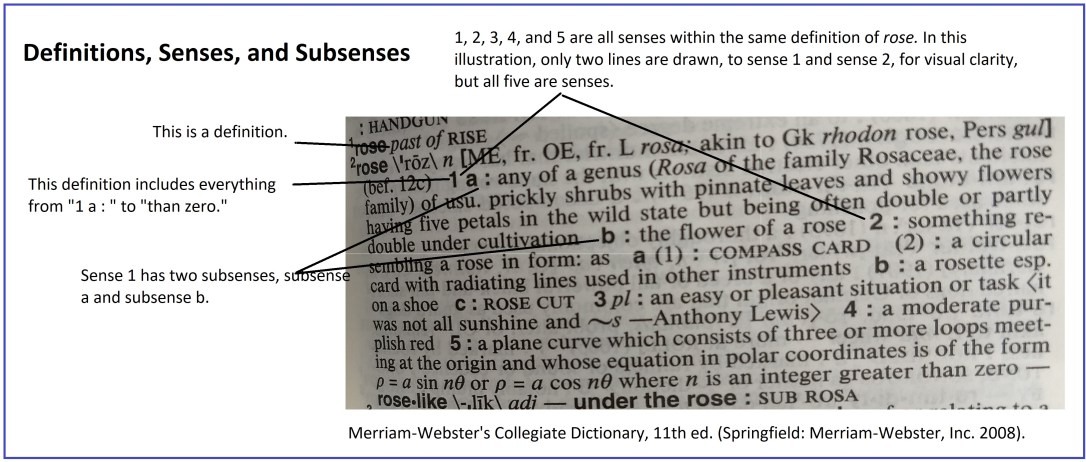
What about core sense?
Core sense is a phrase the editors of American Heritage use for the “typical, central, or ‘core’ meaning of the word in modern standard English.” In that dictionary, they present the “core sense” first within any definition of a word, while other dictionaries have other ordering schemes.
All lexicographers, the people who write and edit dictionaries, follow some system of ordering senses. Unwary dictionary users may not realize the impact the arrangement of definitions and senses for a word can have when we read its definition. Writers, language aficionados, copy editors, and all of us gain the best understanding of a word if we understand the ordering system applied in the dictionary we are using.
But that’s a topic for another day.
The American Heritage dictionary of the English language. (Boston: Houghton Mifflin, 2016).
Merriam-Webster’s Collegiate Dictionary, 11th ed. (Springfield: Merriam-Webster Inc., 2008).

 Perfect Page Services